


Archive for the ‘General’ Category
Oracle Open World Schedule

With over 1900 sessions and 3000 speakers in five days, it is pretty hard setting up a schedule for Oracle Open World. Especially if sessions you want to attend, overlap or being held simultaneously. Finally I came up with the following sessions, I intend to attend at Oracle Open World.
If you want a live report on these sessions, follow me on twitter @hakanbiroglu.
For a detailed daily report on these sessions and the other happenings on Oracle Open World, visit this site again.
Advisor Webcasts for Oracle PeopleSoft Enterprise

Where do search for information on PeopleSoft subjects? PeopleBooks, Forums, Blogs, Wikis, Google, etc …
Most of the time the information you find via these media is either at a high level or specific to a small part of the functionality. What most people do not know is that Oracle is providing Advisor Webcasts on a regular basis for partners and customers. Hosted by the experts on that subject, with a deep dive in the subject, that you will not find anywhere else.
Using RTE enabled fields in BI Publisher with PeopleTools 8.52
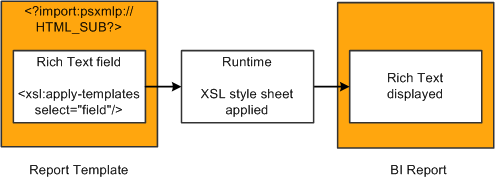
In PeopleTools 8.50 adding a Rich Text Editor to Long fields was introduced. With this RTE users are able to actually format text like you would do in for example Microsoft Word. This was a great feature for online entry and presentation in PeopleSoft. Unfortunately this does have a downside. The text that is entered and formatted using RTE gets stored in the database as HTML. This means that when you are using PSQuery to query the data, the data is presented as plain text with the HTML tags and therefor also not usable in any BI Publisher reporting.
With PeopleTools 8.52 a new tempate is introduced that solves this issue and renders the HTML tags in the Long field to the actual formatting the same way as presented in online PeopleSoft.
I’m Speaking at Oracle OpenWorld. Join Me.

I am proud and honored to announce that I will be speaking at Oracle Open World, among many more community spreakers. To see the full list of spreakers and subjects, please use the following link.
I will be giving a presentation on Five Reasons to Upgrade to PeopleTools 8.52:
- Feature Packs
- BI Publisher Enhancements
- Secure Enterprise Search
- Dashboards
- InterWindow Communication
- Wednesday, Oct 3rd
- 3:30 PM
- Moscone West 3011

Hope to see you there.
Oracle UPK (User Productivity Kit) – Chapter 6. Using web pages in a UPK topic with the developer.
Greetings all,
Index of my blog series.
In the previous chapter, I showed you how to use the UPK Developer to edit a topic by using the frame properties and the configuration items.
This chapter will focus on the usage of web pages within the UPK Developer after the outline has been created.
It is not necessarily to have recorded your UPK topics before you start working with the web pages.
This chapter will cover the following topics:
- How does a web page look in the UPK player
- How to add a web page to a topic
- How to use the web page configuration icons
- How to create the web page